<body>

Thursday, January 7, 2010

MOMENTS OF REAL VERSUS A LIFETIME OF PRETENDING

I choose the moments I have left to be moments without pretending.


When Death Comes

by Mary Oliver

When death comes
like the hungry bear in autumn;
when death comes and takes all the bright coins from his purse

to buy me, and snaps the purse shut;
when death comes
like the measle-pox

when death comes
like an iceberg between the shoulder blades,

I want to step through the door full of curiosity, wondering:
what is it going to be like, that cottage of darkness?

And therefore I look upon everything
as a brotherhood and a sisterhood,
and I look upon time as no more than an idea,
and I consider eternity as another possibility,

and I think of each life as a flower, as common
as a field daisy, and as singular,

and each name a comfortable music in the mouth,
tending, as all music does, toward silence,

and each body a lion of courage, and something
precious to the earth.

When it's over, I want to say all my life
I was a bride married to amazement.
I was the bridegroom, taking the world into my arms.

When it's over, I don't want to wonder
if I have made of my life something particular, and real.

I don't want to find myself sighing and frightened,
or full of argument.

I don't want to end up simply having visited this world.

from the book Ten Poems to Last a Lifetime
page 111-112

~ ~ ~ ~ ~ ~ ~ ~ ~ ~ ~ ~ ~ ~ ~ ~ ~ ~ ~ ~ ~ ~ ~ ~
I am reading the book The Body Never Lies by Alice Miller. And it is so helping me. It says things I have already learned, but find it so helpful to see in print the words. It validates and gives permission to really believe things that have so rung true in my search for living a life fully, free and unencumbered. I have colored the sentences that just made me pause and drink it in.

If you click on the post title, you will go to Alice Miller's website.

From chapter 10, The Body as Guardian of the Truth
a story of Elizabeth from pages 121 - 123
...But, as always I managed to ignore my own feelings and adjust to her mentality...All I had to do was to listen to my own body, because in all the encounters with my mother I was invariably afflicted with severe physical symptoms as soon as I started repressing my feelings. My body appears to be completely unerring in this respect, and my impression is that it knows my truth very well; better than my conscious self...

It would be nice if I could find someone who would let me be as I am, let me say all the things I would like to say, who would not force-feed me with moralistic homilies. This might help me intregrate my painful memories....I am closer to my own feelings than I have ever been before. I can express them...Since I started doing that, my physical complaints and my depression have more or less disappeared.

...I haven't seen my mother once this year, and I do not feel the need to do so. The memories...protect me from any illusions I might have and also from expectations, that she might have something to give me that I missed out on so much as a child. Even though I still miss it from time to time, I now know exactly where there is absolutely no point in looking for it. ...I feel no hatred in me. I do not need to hate my mother because I am no longer emotionally dependent on her.

...failed to understand that. She wanted to free me of my hatred and did not realize that she was unintentionally thrusting me into that hate, which was an expression of my dependency, a dependency she would have created all over again...Today, I no longer need to suffer from pretending that I have feelings for my mother. I don't. That is why there is no hatred left inside me.

And this part I was really grateful to read:
It does not matter so much whether we have to break off all contact with our parents or not. The process of separation, the path from childhood to adulthood, takes place inside us. Sometimes breaking off all contact is the only way in which we can live up to our own needs.

Form Chapter 11 ~ Can I Say It?
page 127
I can well remember the fears that haunted me when I was writing Thou Shalt Not Be Aware.
...I knew quite definitely that I had chanced on an unwritten law, the devastating exploitation of children for the retaliatory needs of their parents and the taboo placed on that reality by society. We shall not be aware.

Did I not risk incurring the severest of penalties if I insisted on breaking that taboo? But my fear also helped me to understand a lot of things...

p 132 -133
...When their parents lie dying, they desperately hope to feel, at the very last moment, the acceptance and confirmation that they never felt in the presence of their parents throughout their whole lives. Dagnmar writes:
Every time I talk to my mother I feel a poison flowing into my body and forming an ulcer there. I try not to see it like that, because seeing it like that gives me guilt feelings. Then the ulcer starts to suppurate, and every time I lapse into depression. I try to admit my true feelings and tell myself I have the right to feel them, to see the intensity of my anger. When I admit my feelings, although they are not always good feelings,
I start to breathe again. I start allowing myself to stay with my true feelings. If I succeed in that, I feel better, more alive, and my depression disappears.

...But, how can I respect myself if I don't take my true feelings seriously? If I don't do that, I don't know who I am, I don't know who I'm supposed to be respecting.

~ ~ ~ ~ ~ ~ ~ ~ ~ ~ ~ ~ ~ ~ ~ ~ ~ ~ ~ ~ ~ ~ ~ ~

See the comment section for personal writing

Labels: , , , , , , , ,

Thursday, August 6, 2009

PERSONAL STORY CROSSES THE THRESHOLD - WILL YOU BE KIND?

This turned out to be a free association post. I start with sharing a personal video of my son before he was my son. My pride in his accomplishments with a video he produced, edited as a high school project in Latin class, winning a Bronze Chalice Award. I am so pleased with the young man he is ~ as he has shown me in his young adult years.

I talk of spanking and beating children. My own experience and the aftermath of being beaten with a leather belt by people who were supposed to love me. And why I think it is wrong to hit children.


I always feel ambivalent about this type of a post. Being the big ugly world and baring my soul, including my son's - it is questionable that I should cross this threshold. The last time I did it, I came back a few days later and deleted most all of the post.

Here . . . . .
for now

This is the very first video footage of Jonathan. I met him at the end of October 1995. At the time, he was in Mrs. D's second grade class and living with one of several foster families that he was placed with over the course of two years. He was one of hundreds of music students that I was teaching in a public school that year. On this day, he was visiting our home and I got out the huge video camera that I owned. Since March of that year, I was giving him free piano lessons and helping him with his speech lessons with the blessing of the foster family. On this day, we had planted a bush in the front yard and named it after him. That bush didn't survive and thrive, but Jonathan has! He is wearing Mark's sweater, here, which I now use for work in the yard when it is cold. Although the video tape was defective since the the day I shot this, my video teacher helped me in June 2009 with his great equipment in video class, to transfer it from my VHS video tape.... so that I could upload this on my computer and then I could share it with Jonathan on youtube. It came out much better quality than how it had deteriorated on the tape. So I am thrilled as Jonathan is so adorable in these few minutes. It has been for "private" viewing only until now, as I share it here.
.....................................

.....................................
Jonathan dances
Jonathan's First Video Footage - May 27, 1996
Music: "Starting All Over Again" by Hall and Oates.
Uploaded by lovemylifesblog originally on June 23, 2009

~~~~~~~~~~~~~~~~~~~~
~~~~~~~~~~~~~~~~~~~~
March 8, 1999

We adopted Jonathan March 8, 1999. He is getting his undergraduate and Masters degree simultaneously in engineering in Boston - one of the top engineering students at Northeastern University. I slightly modified the text above which is from my Youtube page. I ended the Youtube text with these words . . .

Enjoy, Jonathan. You are something special.

Love, Mom

Lyrics to the song:
Starting all over again is going to be rough
For us, we're going to make it
Starting all over as friends is going be tough
On us, we gotta face it

We lost what we had
That would hurt us so bad
Set us back a thousand years
But we going to make it up
Though I know it's going to be tough
To erase the hurt and fears

Starting all over again is going to be hard
But I pray to the Lord to help us make it
Starting all over again is going to slow
But we both know, we gonna make it

We gotta take life as it comes
Never fuss about it, what's right or wrong
It's an uphill climb, to the finish line
We gonna try, we gonna try, just one more time

We gotta take life as it comes
Don't make any fuss about it, what's right or wrong
We gonna make it up, though I know it's gonna be rough
To erase the hurt and fears

Starting all over again is going to be rough
For us, we're going to make it
Starting all over as friends is going be tough
On us, we gotta face it.


The words are somewhat appropriate...what do you think?


End of text from my Youtube page

When Jonathan was in his third year of high school, his Latin teacher had him use his digital still camera that had a feature of shooting brief video bits on it. And he was asked to enter a contest with a video of the project by his Latin teacher. He produced and edited this video. http://ablemedia.com/ctcweb/showcase/Hammel%20Caesar%20Movie.wmv
He won the Bronze Chalice Award

The following text is from the Able Media website:

Veni, Vidi, Vici: Caesar vs. the Helvetii

John Hammel, Moses Brown School


Movie Presentation

Assignment Parameters

As described by teacher Ruth Breindel: "Some background on the project: every year we stage the battle between the Helvetians and Caesar, concentrating on Book I.21-29. Usually we do it in the field house, but this year, because we couldn't use it, we did it in a new part of the building. I always take still shots of the battle, but by chance John had brought his digital camera this year. It also makes short films, so after he filmed everything, he put it together with the music and brought it to class."

As described by student John Hammel: "It started off as a learning experience, hands on learning. I decided to use my digital camera to record the class reinacting a scene from Caesar's Gallic War. I went home and began to create the video. I learned of the assignment after I began creating the video, which was to create something to represent Caesar and what we had translated of his Gallic War."

Technical Information

Movie was shot with a Kodak Digital Camera and edited with Roxio Video Wave Movie Creator. Some of the translations included on the video were original while others relied upon the Forum Romanum website http://www.forumromanum.org/literature/caesar/gallic1.html


Veni, Vidi, Vici: Caesar vs. the Helvetii

by John Hammel, Moses Brown School,
Providence, RI

Original Movie © 2005. John Hammel. All rights reserved.

Edgy camera work merges with ancient Latin script in Hammel’s Veni, Vidi, Vici to evoke the Götterdämmerung wrought by Rome and the steely generalship of Julius Caesar in Book 1 of Julius Caesar's De Bello Gallico. Hammel combines heavy metal music, model soldiers, and gritty commentary in Latin and English to dramatize Caesar’s crushing defeat of the Gallic tribe, the Helvetii.

Veni, Vidi, Vici: Caesar vs, The Helvetii


Source: http://ablemedia.com/ctcweb/showcase/hammelindex.html

~~~~~~~~~~~~~~~~~~~~~~~~~~~~~~~~~~~~

The website had Jonathan answer the following questions after winning the Bronze Chalice Award

In Personam: John Hammel


To which classical figure do you most relate and why?

Hercules because of his childhood.


What book has been most influential to your career?

A Problem from Hell: America and the Age of Genocide by Samantha Powers


If you could travel back to ancient Rome, what five items would you take with you from the present?

Aspirin, Monopoly (I may be able to finish the game for once), Toilet paper and Kleenex, and I would also take a lot of books: Latin Dictionary, Ancient World History Texts, Science books (Chemistry, Physics [so that I can make money being a magician.]) and every other book that I could possibly think of.


What book are you currently reading?

The Great Gatsby and The Millionaire’s Dinner Party (as a part of Latin Class)


If it were possible, with whom, dead or alive, from the world outside of Classical Studies would you like to have dinner?

Leonardo Da Vinci.


What albums would you want to have with you if you were stranded on a desert island?

Pearl Jam – Greatest Hits; Guns N’ Roses – Greatest Hits; Aerosmith – Greatest Hits; Red Hot Chili Peppers – Greatest Hits; ACDC – Back in Black


If it were possible, with whom, dead or alive, from Classical times would you want to deliver your eulogy?

Cicero.


What trend in Classical Studies do you see as positive?

Hands on learning in classroom; learning by doing rather than being taught at.

John Hammel is a student at Moses Brown School in Providence, RI. Hammel is the winner of AbleMedia's Bronze Chalice award for his submission of Caesar Video.

Who has been the most important mentor in your career?

All of the teachers that I have ever had. They have all affected me in different and unique ways


How would you like to be remembered?

As a good person - Caring, Compassionate, understanding and above all a great friend


What is the best advice you have ever received?

“Never take your work too seriously.” - friend


What law, rule, event, or custom from Classical times would you like to see reincarnated today?

Community leisure - Resuscitations of Stories and being together, Community Entertainment.


What is the most interesting thing in your car right now?

Lounge Chair.


Summarize yourself in the title of a Classics paper?

"The Ancient World in Modern Form."


What would be the title of your autobiography?

Phoenix.


What trend in Classical Studies do you see as negative?

My personal problem would be memorizing vocabulary. Although I do regard memorizing as an important aspect to Classical Studies, it could be made much more interesting through games and PowerPoint presentations, Interactive.


Humiliations, spankings and beatings, slaps in the face, betrayal, sexual exploitation, derision, neglect, etc. are all forms of mistreatment, because they injure the integrity and dignity of a child, even if their consequences are not visible right away. However, as adults, most abused children will suffer, and let others suffer, from these injuries. This dynamic of violence can deform some victims into hangmen who take revenge even on whole nations and become willing executors to dictators as unutterably appalling as Hitler and other cruel leaders. Beaten children very early on assimilate the violence they endured, which they may glorify and apply later as parents, in believing that they deserved the punishment and were beaten out of love. They don't know that the only reason for the punishments they have ( or in retrospect, had) to endure is the fact that their parents themselves endured and learned violence without being able to question it. Later, the adults, once abused children, beat their own children and often feel grateful to their parents who mistreated them when they were small and defenseless.

This is why society's ignorance remains so immovable and parents continue to produce severe pain and destructivity - in all "good will", in every generation. Most people tolerate this blindly because the origins of human violence in childhood have been and are still being ignored worldwide. Almost all small children are smacked during the first three years of life when they begin to walk and to touch objects which may not be touched. This happens at exactly the time when the human brain builds up its structure and should thus learn kindness, truthfulness, and love but never, never cruelty and lies. Fortunately, there are many mistreated children who find "helping witnesses" and can feel loved by them.

I was raised with being whipped by both of my parents with a leather belt. I believe it is wrong to spank or whip children. I believe it is wrong to humiliate children. I believe it is our job as parents to build their inner strengths, a belief in themselves, a trust in their own wisdom and nurture their natural talents and strengths of character. My son had all of these things - beatings, humiliations, neglect, witnessing others being beaten... happen to him and worse. But before he was adopted. Never once since he was adopted.


It has always taken a huge amount of courage for me to speak up to my authoritarian, over-reaching parents even as an adult. However, I spoke up once to my father when he was striking my young niece at his house when he was watching over the grandchildren when I was visiting from Rhode Island.

I had learned from a principal that hitting was not the way to carry on and found other ways as a teacher to deal with a child's correction needs.

I told my father that he could choose to sit my niece on the sofa for a time and not strike her any more. Dad made a comment later to me that she responded appropriately with this manner of correction. I believe it made a difference.

I know I am affected as an adult by these leather belt episodes in my younger life. I was affected also because I couldn't protect my older brother from the terrible beatings that I witnessed him getting. Years later I experienced a draining memory of one of these episodes of witnessing my brother bear the "acting out" of our dad. Even when I was in college and my sister was in high school, I took her to the living room to huddle in the corner during another time of outrage being carried out on our brother. The effects will never completely go away.

Consistency is the key to correction. The spanking and beatings need to stop.

If you strike your children or humiliate them, ask yourself what kind of relationship do you want with your adult children? Because spanking , humiliating them - provoking their fears as children - will affect them, their relationships throughout their lives and your relationship with them now and in the future when they are adults. I know my putting up with an abusive boyfriend in my thirties, would not have been acceptable to me had I not had the acceptance that I could be hit by someone who "loved" me. Everything has its foundation in our childhoods. Adult anxiety, reinforced fears and depression.

And if your son sees you hit your daughter, what is he learning from you? He is learning it is okay to hit a woman. And he is learning someone who loves you can hurt you and it is supposed to be all right.

It is not all right.

When you are elderly, and your adult children could take advantage of your vulnerable state, do you want it to be acceptable for them to hit you? Elderly abuse happens. A lot.

Abuse is a cop out versus being wise, patient and putting yourself in someone else's "shoes". Do unto others as you would have them do unto you ~ that line is the most important thing my parents ever said to me from their Christian values. Sad they didn't live it.

Especially when I was a child.

~~~~~~~~~~~~~~~~~~~~~~

On Children by Kahlil Gibran

And a woman who held a babe against her bosom said, "Speak to us of Children."
And he said:


Your children are not your children.


They are the sons and daughters of Life's longing for itself.


They come through you but not from you,

And though they are with you, yet they belong not to you.

You may give them your love but not your thoughts.

For they have their own thoughts.

You may house their bodies but not their souls,

For their souls dwell in the house of tomorrow, which you cannot visit,
not even in your dreams.

You may strive to be like them, but seek not to make them like you.

For life goes not backward nor tarries with yesterday.

You are the bows from which your children as living arrows are sent forth.

The archer sees the mark upon the path of the infinite,
and He bends you with His might that His arrows may go swift and far.
Let your bending in the archer's hand be for gladness;
For even as he loves the arrow that flies, so He loves also the bow that is stable.

On Teaching

Then said a teacher, "Speak to us of Teaching."
And he said:
No man can reveal to you aught
but that which already lies half asleep in the dawning of our knowledge.

The teacher who walks in the shadow of the temple, among his followers,
gives not of his wisdom but rather of his faith and his lovingness.
If he is indeed wise he does not bid you enter the house of wisdom,
but rather leads you to the threshold of your own mind.

The astronomer may speak to you of his understanding of space,
but he cannot give you his understanding.

The musician may sing to you of the rhythm which is in all space,
but he cannot give you the ear which arrests the rhythm nor the voice that echoes it.

And he who is versed in the science of numbers can tell of the regions
of weight and measure, but he cannot conduct you thither.

For the vision of one man lends not its wings to another man.
And even as each one of you stands alone in God's knowledge,
so must each one of you be alone in his knowledge of God
and in his understanding of the earth.


Labels: , , , , , , , , , , , , , ,

Friday, June 26, 2009

DARFUR WITHOUT JUSTICE IS DARFUR WITHOUT PEACE

As the government of Sudan, keeps saying there never has been genocide on the Darfuri families, I always want to have this question answered:

So if you aren't perpetrating the burning of villages, the killing of thousands, raping the females, maming and gouging eyes out, why aren't you charging those who are? Where is the justice, President Omar al-Bashir?

..................................................

..................................................
iACT 8, Day 9, June 23, 2009
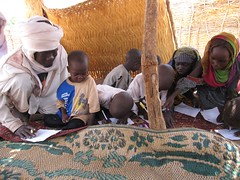
There is so much joy in seeing our family in the camps, and also so much sadness that comes with knowing their stories. After all the crazy days to prepare for World Refugee Day events, we finally get to sit with our friends and enjoy the simple parts of life, like drawing pictures.
Uploaded by stopgenocidenow

Day 9 Action: Steps for Peace
Posted by Katie-Jay on June 22nd, 2009

This week the Obama Administration has brought together key signatories and over 30 countries in Washington to discuss the fate of the Comprehensive Peace Agreement (CPA) in Sudan. John Norris, Executive Director of ENOUGH Project, noted recently, “One of the key problems with the CPA to date has been the fact that the parties to the CPA, particularly President Bashir’s National Congress Party, have not faced any cost from the international community for a failure to implement key provisions of the agreement. Unless that changes, conflict in Sudan will only intensify.”

We cannot allow this to happen. The US must be a leader in the international community. After meeting the beautiful people of Darfur, we are responsible to act. While these important leaders are in Washington, take action:

1. Call you member of Congress through the Capitol switchboard at 202.225.3121.Urge them to hold hearings on Sudan and continue to make this issue a high priority for Congress.

2. Sign the open letter to President Obama encouraging his administration to address the immediate humanitarian crisis in Darfur and to achieve long term peace through a political solution for all of Sudan.

Read more about the CPA and Sudan by ENOUGH.


Four
Posted by Gabriel on June 22nd, 2009

IMG_1964.JPG I know the name of three. I feel bad that I did not ask the name of the fourth. Marymouda is the last one. The first and second were Issa and Abrahim. The third died on his mother’s back, as she, Adef and remaining siblings escaped from Darfur. They have lost four children in six years. Who’s counting? Someone should be held accountable.


...............................................................

...............................................................
War ~ No More Trouble
Uploaded by PlayingForChange


Scars
Posted by Katie-Jay on June 22nd, 2009

Family drawing We have a days rest in Abeche before three of our team members move on to Guereda where Camp Kounoungo is located, and one, Eric, begins is several day journey back to Los Angeles. It doesn’t seem like a break. I feel more restless today then any other day since our arrival in Chad. There are any number of tasks that I could be doing, but instead I click through pictures in iPhoto, allowing myself to be transported back to our friends in Camp Djabal.

Abdelmouni, now three years old, is Adef’s serious young man. The giggles and almost consistent smile Bashar, Bashir, and Guisma get from Achta. Adef and Abdelmouni, although they have great laughs too, are more serious and stern. In almost every picture Abdelmouni’s “look” is captured. Only a tickle on the neck or showing him his picture on the camera will get him to giggle. His three older siblings catch the contagious laughter. I wonder what Gbryl (prounounced Ge-briel) will be like. Will he too have a contagious laugh.

Little Gbryl I think about the pain that Achta and Adef must feel after losing four of their children. Guisma is the only girl they have left; of nine children that she has birthed. Nine. Their oldest son, Abrahim, would be 18 years old, the next oldest would be 15. Instead, it is Bashar and Bashir at 8 years old. They were only 3 when they fled their homeland. I wonder what they remember, if anything.

Achta has a great scar on her arm. It is raised with two large oval scars meeting like tips of tear drops touching with another straight scar that is perpendicular. I slowly pass my fingers over them and ask her what happened. Our translator has not arrived. Adef simply points at his wife’s arm, makes a gesture like he shooting an AK-47, and says, “Janjaweed.” Today Achta’s arm still hurts as she bears the scars of gun shot wounds and perhaps more painful, the scars of losing four children.

I don’t know how Achta and Adef feel. But when we ask them what they hope for and what they need, it is always the same. They want justice in order for peace. And they want their children to be educated so Darfur and Sudan will be stronger because of the next generation.

~~~~~~~~~~~~~~~~~~~~~~~~~~~~~

www.flickr.com/photos/stopgenocidenow
Link to pictures of June 23, 2009

~~~~~~~~~~~~~~~~~~~~~~~~~~~~~

Write to President Obama
http://www.whitehouse.gov/contact/

You can also write to the President at:
The White House
1600 Pennsylvania Avenue NW
Washington, DC 20500

President Obama can be called:

202-456-1111
or
1-800-GENOCIDE

The White House comment line is available
9:00 a.m. - 5:00 p.m. weekdays

~~~~~~~~~~~~~~~~~~~~~~~~~~~~~~~

Find USA elected politicians contact information at this link:
www.usa.gov/Contact/Elected.shtml

~~~~~~~~~~~~~~~~~~~~~~~~~~~~~~~
www.stopgenocidenow.org


www.enoughproject.org
www.savedarfur.org
www.eyesondarfur.org

whilewewaitsudan.blogspot.com

>:>:>:>:>:>:>:>:>:>:>:>:>:>:>:>:>:>:>:>:


OBAMA'S DARFUR PROMISE

By Susan Morgan

www.huffingtonpost.com

During the campaign, when asked about the genocide in Darfur, Candidate Obama said, "We can't say 'never again' and then allow it to happen again. And, as President of the United States, I don't intend to abandon people or turn a blind eye to slaughter." The candidate also spoke of "ratcheting up sanctions" and "organizing the European Union to be a part of those sanctions." His campaign's policy paper, titled the "Obama-Biden Plan," stated, "As president, Obama will take immediate steps to end the genocide in Darfur by increasing pressure on the Sudanese and pressure the government to halt the killing and stop impeding the deployment of a robust international force."

Fast forward to June 2009. Thus far, President Obama and his Administration have displayed no "immediate" response to the Darfur crisis or any willingness to "pressure" the Sudanese government. Instead we have seen stalls, delays and a very worrisome conciliatory tone in the U.S. response to the ongoing genocide in Darfur. According to a recent article in the Washington Post, Obama's Special Envoy to Sudan, retired Air Force Maj. Gen. J. Scott Gration, has advocated easing some American sanctions and upgrading U.S. diplomatic relations with Sudan's government to induce cooperation.

Many Darfur activists, whose votes for Obama were influenced by his impassioned statements about the responsibility to act in the face of genocide, feel betrayed. Darfuris, who named babies after Obama and waited hopefully for him to take office, feel understandably abandoned.

Concern amongst grassroots activists (aka voters) as well as amongst the Darfuri refugeesfirst press conference, Gration not only contradicted both the President's and U.S. Ambassador to the U.N.'s assessment of the crisis in Darfur as an "ongoing genocide" but also the facts when he stated that the aid levels have returned to nearly 100% of their previous levels before the forced expulsion of 13 foreign aid groups by the Government of Sudan.
reached its peak this week due to comments made by Special Envoy Gration. During his

In fact, according to John Holmes, the U.N.'s emergency relief coordinator, the new aid workers "have not yet replaced, and cannot easily or rapidly replace, the capacity and skills lost." Gration's description of the crisis as the "remnants of genocide" was also disproven in the latest report by U.N. human rights investigator, Sima Samar, covering from last August to her visit to Sudan earlier this month. This report accused Sudanese forces of continuing to carry out land and air attacks against civilians in Darfur, in violation of the world body's resolutions during the reported period. She cited reports that Sudan's security forces have arrested and tortured human rights activists and aid workers.

As if to underscore the points made in the report, on the day it was issued, members of the government's National Congress Party (NCP) brutally attacked female students from Darfur who had convened a meeting in the dormitory at the University of Khartoum to discuss crimes of the government against the people of Darfur. Female NCP supporters accompanied by male security agents disguised in female attire attacked the Darfuri female students with iron bars, bats, and knives. Many were seriously injured.

Some grassroots activist leaders together with Darfuri leaders in IDP camps are calling for Gration's replacement. In a letter to President Obama, Martina Knee, a member of the Executive Committee of the San Francisco Bay Area Darfur Coalition writes:

"Since the appointment of General Gration, the Government of Sudan has bombed Darfuri villages and Chad, sentenced over 100 Darfuris to death after unfair trials, censored its media, and arrested and detained human rights activists in unknown locations. His approach to Sudan has emboldened this genocidal regime who he treats as rational actors. He ignores the 20-year history of tyranny, slaughter and broken agreements."


Whether Gration's statements represent a dramatic shift in the Administration's policy or were merely careless or misinformed, they indicate clearly that Obama's attention to the Darfur crisis is missing. It is hard to imagine such a serious misstep taking place in a press conference held by George Mitchell on the Middle East or by Richard Holbrooke on Afghanistan. Instead, when it comes to the Administration's response to the first genocide of the 21st century, the usually well-oiled machine seems to need a mechanical overhaul.

Five months into his presidency, the people of Darfur have waited long enough for Barack Obama to keep the promises of his candidacy. Victims of genocide deserve the immediate and direct involvement of the President himself. Many may argue correctly that the President has other pressing issues before him and cannot possibly engage with them all immediately. However, in his own words "ongoing genocide" carries with it the "moral imperative" to act.

The facts speak for themselves. Government of Sudan (GoS) planes are bombing defenseless Darfuri refugees in camps in Chad and its own citizens in IDP camps in Darfur. More than three months after the GoS expelled 13 foreign aid groups from the country, 1.5 million people are still waiting for adequate food, water, sanitation and medical care to be restored. Efforts to convene a civil society conference on Darfur with the aim of building what its organizers call "a mandate for peace" were derailed by the GoS. The GoS executed nine men on April 1, who may have been innocent of the crimes for which they were convicted. Over 70 more men await a similar fate. Their confessions were reported to have been extracted under torture.

Five months after the inauguration, the U.S. State Department, still hasn't completed its lengthy review or unveiled its long-awaited Sudan policy. And the Special Envoy, a man with no prior experience with Sudan or diplomacy, seems to be marching to his own conciliatory tune.

This disarray in policy could not come at a worse time. The Chief Prosecutor for the International Criminal Court has warned that a decision by the Court is imminent on whether to add a genocide charge against Sudan's president Omer al Bashir to the other already approved charges of war crimes and crimes against humanity. According to experts at the Enough Project, "many fear the response from Khartoum, which could result in either a government seeking retribution or a government emboldened. As one source put it: 'I read this as a warning to the international community to get prepared.'"

Yet we are not prepared. President Obama -- it is time for you to step in. You must lead the United States and the international community to ensure peace in Darfur and in all of Sudan. You made a promise to the people of Darfur and to the many American voters who care about them. Please keep it. Otherwise, as you said during the campaign, it will be "a stain on all our souls."


Labels: , , , , , , , , , , , , , , , ,

CALLING OUT OUR LEADERS WHO ARE MORAL PRETENDERS


It takes political will to prevent and take the steps needed to stop genocide.

Since 2003, the world has had chance after chance to act regarding the genocide on the Darfuri families who now live in refugee camps, if they haven't been killed.

So leaders of the world, you just don't care about genocide.


CARING IS HUMAN

SO WHY DO WE GO WRONG AS A RACE?


~~~~~~~~~~~~~~~~~~~~~~~~~~~~~~~~~~~~

When we can watch people from around the planet mourn Michael Jackson's death, Darfuri people who have lost their lives get no such attention.

What does it say about us that we can turn away from those in need, when we have the ability to help?

What does it say about us that we are like moths to a flame to stories of celebrity, but stories of humanity and inhumanity simply are ignored?

When "it" isn't happening to us, few care.

~~~~~~~~~~~~~~~~~~~~~~~~~~
I am still playing catch up with the posts from the iACT team visiting the Darfuris

If you want to see all the days posted, use this link
http://www.stopgenocidenow.org/iact/iact8
As of today, each day has a post for June 15 through June 25, 2009 at the above link.


Day 11 Action: Hope Lies in the Babies
Posted by Katie-Jay on June 25th, 2009

During this i-ACT we have called the White House, Special Envoy Gration and sent text messages to Secretary of State Clinton. Today is the time to bombard the White House email box. Cut the message below and Paste it to the White House Comment Box:

Dear President Obama: obama_baby.jpg

With your election, Darfur refugees had as much hope as I that you would work with “unstinting resolve” to bring peace and justice to Darfur and all of Sudan. Mothers and fathers have named their new born sons after you, and students have renamed their schools Obama. They still believe that if the United States becomes a leader in the movement to bring justice and peace, then the international community will follow. Will you stand with the people of Darfur?

Please finish the Sudan Policy Review, support the arrest warrant for al-Bashir, and work multilaterally to bring peace to all of Sudan.

Salaam,

Your Name

Read Speaker Pelosi’s World Refugee Day Statement.

Missed our live feed from Chad for World Refugee Day? View segments of the day here.


~~~~~~~~~~~~~~~~~~~~~~~

Write to President Obama
http://www.whitehouse.gov/contact/

You can also write to the President at:
The White House
1600 Pennsylvania Avenue NW
Washington, DC 20500

President Obama can be called:

202-456-1111
or
1-800-GENOCIDE

The White House comment line is available
9:00 a.m. - 5:00 p.m. weekdays

~~~~~~~~~~~~~~~~~~~~~~~~~~~~~~~

Find USA elected politicians contact information at this link:
www.usa.gov/Contact/Elected.shtml

~~~~~~~~~~~~~~~~~~~~~~~~~~~~~~~
www.stopgenocidenow.org


www.enoughproject.org
www.savedarfur.org
www.eyesondarfur.org

whilewewaitsudan.blogspot.com

>:>:>:>:>:>:>:>:>:>:>:>:>:>:>:>:>:>:>:>:

..........................................................

..........................................................
iACT 8, Day 8 June 22, 2009
From Darfuri refugee camp
Uploaded by stopgenocidenow

Day 8 Action: Be Heard
Posted by Katie-Jay on June 22nd, 2009

Let us be heard by our leader, President Barack Obama. Everyone we meet has faith that he will do the right thing. We even met one man who named is newborn son, Obama because President Obama believes in peace, justice and democracy. Unfortunately, President Obama is like most other politicians in that his actions are motivated by re-election. He needs to hear from you.

This week, between 9am-5pm EST, call the White House 202-456-1111 and tell President Obama to bring justice and peace to Darfur.

If you get a busy signal. Please don’t give up. Call back, usually it takes a few quick dials within a few minutes to reach one of the White House Operators.


The Humanitarians

Posted by Ian on June 22nd, 2009

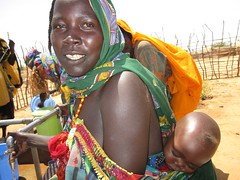
mother and baby at water station We have all been quite active here in Goz Beida, Chad the last few days. Anyone following the website is well aware of the World Refugee Day activities, and if you saw any of the videos, then you might have an idea of the extensive preparations that went into them as well. This has been one of the most satisfying experiences of my life, and we still have a few days left. The thing that has been on my mind a lot is the intense humanitarian effort on the ground in Chad. The people that work with the UNHCR are simply amazing. Before I got here, I had no idea what UNHCR stood for, now I am a beneficiary of their generosity and knowledge. I can’t imagine working here everyday in the heat, dust, and lack of Starbucks. It’s a thankless job. In this arena, the world is focused on the genocide and how horrible it all is on one side, and on the other side, the UNHCR fields all the refugee’s complaints. In reality, the UNHCR and all the satellite NGO’s here are providing the necessary amenities and infrastructure for people in the camps to survive. Without them, the numbers of deceased would be dramatically higher. I keep thinking to myself, how in the world could anyone be down here for more than two weeks, let alone a year to year and half, which is the length of most contracts. I have developed a sense of guilt about coming in for such a short time, while the refugees and the humanitarians here grind it out…day after day…in conditions that are extremely difficult, if not impossible. This leads me to think about some of the comments and correspondences I’ve had from friends and family over the last week.

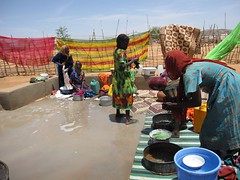
washing clothes Many of my friends have written, sometimes in the same sentence, that they are very impressed with what I’m doing, while at the same time feeling it’s a reminder that they’re stuck in an office doing the same old job over and over, which isn’t that fulfilling. (I’m paraphrasing) I suppose it’s a positive thing to have these emotions of feeling stagnant arise, and begin to ask the questions of how to move beyond our own repetitive situation. If I’m the catalyst to that, then so be it. If the instinct is to move, then it’s probably the thing to do. The level of action will most likely be different for everyone as well. I don’t encourage everyone to quit their jobs and hit all the front lines of every conflict around the world, but you could do a humanitarian vacation to start. However, I think being a humanitarian starts on the most basic level, respecting others. That is probably the hardest step of them all. At least for me it is.

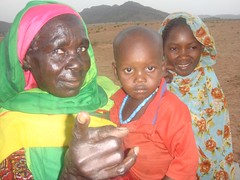
look at the camera Even though I’m here in support of refugees, I almost lost my cool with a group of kids the other day in the camps. I needed them to back away from the person I was filming and keep silent. But instead, they kept on crowding me, grabbing at my “manpurse” and my arms, while repeating everything I said. I would make aggressive gestures with my arms to step away and sternly yell “back, back,” and immediately a chorus of ten kids would repeat “back back” and keep advancing. Their laughter made me feel mocked and I wanted to smack those little f#@*!, but then I remembered they didn’t speak my language, (nor I their’s) and I had just spent the last few days encouraging them to repeat all my words and gestures, so in a sense, I created a monster. Not to mention, they had just survived genocide, so I cut them some slack. But I was still frustrated! Point is, if I’m going to get upset with those that might deserve more patience than anyone, it’s probable that every human being on earth is going to get under my skin at some point. So the challenge is there for me personally. It’s a hell of a lot easier to be a humanitarian when you’re surrounded by them everyday, but how do I become a humanitarian in everyday life? That will remain to be seen. But if we all crack that one, it could be contagious.


A meeting with Obama

Posted by Gabriel on June 22nd, 2009

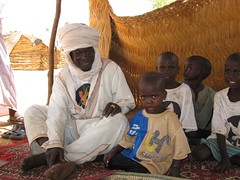
Adef reading We’re sitting in a hut in the middle of camp with a group of men, talking war, politics, and pain. It is hot, and there are flies everywhere, the kind of flies that think nothing of swatting. It is only the men and us, no children and no laughing. One of them, soft-spoken and wearing their traditional head-scarf that protects them from heat and sand in the desert, starts listing all the attempts at negotiations between rebels and Khartoum government and all the signed agreements–all failed and unkept. Do they, Khartoum, really want to find a peaceful solution? “No, they want all blacks out of Darfur.”

Another even more serious looking man and even more soft-spoken, looks at me straight in the eyes and keeps that eye connection the whole time he speaks–no blinking. We are only about seven feet away, and I feel uncomfortable–I am not sure why, but it must be that, with the look, he is telling me “Now you know. You are responsible.” He is dressed in safari green pants and long-sleeve shirt–very clean and neat. “Justice. Without justice there is no peace. If you start with justice, peace follows. Then we can go home.”

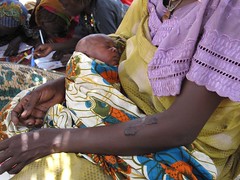
We leave the hut and follow the serious man in green, walking all the way to the other side of the camp. He has us sit in a much cooler hut than the one before, and there are no flies. His wife joins us and is carrying a beautiful 20 days old boy. “His name is Obama.”


It takes EFFORT

Posted by Katie-Jay on June 22nd, 2009

Team Work Today was our last day in Camp Djabal. I already miss them all and it has only been hours. I don’t know when I will be able to come back to Camp Djabal. I fear it will be longer than I want, and that the conditions of the camp will be worse. It makes me sad to think that some may not even make it until our team returns.

In the camp this morning, the sun beat down on the sand, and our backs as we weaved through the straw made alleyways searching for Adef and Achta. We asked one tall man, who smiled, pointed and began to walk beside us.
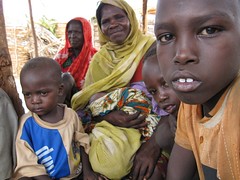
Achta Abdelmouni Madi watching We soon found our family. I feel very close to Adef and Achta. For about an hour we exchanged with gestures before a translator came. Without words, Achta knew what I was trying to tell the children and she helped direct them. I distributed pens and paper for the children, and a book for their family. Abdelmouni is becoming a little man, still serious, but when he laughs it is the loud giggle of his sister and brothers. I feel so close to them, as if they are part of my own family. In many ways, they are.

They don’t ask for much. Many people I know would be asking for so much if they were in a situation that the refugees, or even IDPs from Chad, were in. I think because we have grown up in such a rich country there is a sense of entitlement to having things, to having everything. Not so much here. What they want is education, justice, and peace. Justice so that Peace will come and Education so they can help lead their country.
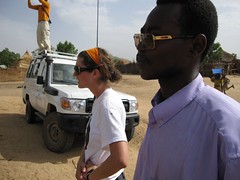
Abdullaziz ktj IH on car These are simple concepts that will require effort on the part of the international community. Skilled mediators, Financial Support. Disarmament. Arrest warrants acted on. Educational support through trainings, supplies, and infrastructure. These are things we in America take for granted most of the time. These are things that will help ensure that little Abdelmouni, Guisma, Bashir and Beshar grow up having some chance at leading fulfilling lives. The kind of life we expect to be handed to us.

Maybe I am being to harsh on the country I grew up in. I may be acting on pure emotional response to the serious eyes of a three year old and a laugh of a young girl that used to roar and now rarely giggles. And I know that there are people throughout the world who are suffering, like those who have been injured or killed fighting for democracy in Iran. I know that Darfur and Chad are not the only places where people are seeking peace, justice, education and participation in the leadership of their people.
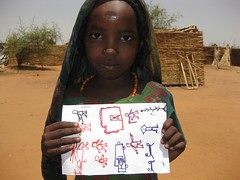
girl w drawing I just know personally that if I don’t work harder to bring peace and justice to Darfur and all of Sudan that my friends here will not go home. They will not have the opportunity to live fulfilling lives. They will not have choices. They will slowly begin to lose their culture as more generations grow up in camps outside of their homeland. Their entire world has already changed, and they adjusted as much as we can ask someone to adjust. In the end, they want to go home.

Please be part of allowing peace, justice, education, and CHOICE back into their lives.

paz, ktj


Pictures of iACT 8, Day 8 June 22, 2009 while with the Darfuris:

http://www.flickr.com/photos/stopgenocidenow/3648441478/

~~~~~~~~~~~~~~~~~~~~~~~~~~~~~~~~~~~

Below is news from Mohamed Suleiman, a Darfuri, who presently lives in the USA. He has relatives still living in Darfur, being affected by the genocidal acts of the government of Sudan.

Ghazi Salahuddin with audacity


Ghazi Salahuddin has a lot to show how his NCP has accomplished in bringing peace to Darfur: on papers! Hundreds of pages signed by NCP in 2006, he said , where all problems of Darfur were addressed.

Ghazi now advises the U.S. Administration to exert maximum preasure on Darfur rebels and the countries "support" them to sign more papers.

Ghazi got a slick PR advice: Take advantage of the American Free Speach ( NCP forbids all kinds of freedom in Sudan), and take your case directly to the American paper, talk about PEACE IN DARFUR.

Read what Ghazi Salahddin wrote in Washington Times, about giving PEACE in DARFUR:

http://washingtontimes.com/news/2009/jun/23/give-peace-a-chance/print/


Why Gration is Dead Wrong on Darfur

There is nothing called " Remnants of Genocide" when it comes to dealing with the crime of Genocide.

Gration's words help only one party: Perpetrators of the Genocide crime i.e. Khartoum Government.

As defined by U.N. Convention on prevention and punishment of crime of Genocide, the destruction of the people of Darfur is going on NOW. That is GENOCIDE.
Please read:

http://www.hrweb.org/legal/genocide.html

~~~~~~~~~~~~~~~~~~~~~~~~~~~

Forwarded from US MA Senator Kerry’s office

United States Senate Committee on Foreign Relations

WASHINGTON, DC

FOR IMMEDIATE RELEASE

June 23, 2009

Contact: Whitney Smith, 202-224-4651

Kerry Urges North and South Sudan to Implement Comprehensive Peace Agreement

WASHINGTON, D.C. " In a keynote address at last night’s Forum for Supporters of the Comprehensive Peace Agreement (CPA) in Washington, D.C., Senate Foreign Relations Committee Chairman John Kerry (D-MA) called on both North and South Sudan to make the compromises and decisions necessary to make the peace accord a lasting reality and a foundation for peace in Darfur. The forum was hosted by President Obama’s Special Envoy to Sudan, General Scott Gration.

We need to think of the CPA as a process, not an event,” said Kerry. “The signing of the Naivasha Accords marked the end of the war, but only the beginning of the peace. Our challenge going forward is to ensure that the CPA does not become one more piece of paper littering the bloody history of Sudan. The reality is, both sides need to want peace more than they want victory at any cost. That’s the only way to make the right decisions. You cannot expect to get everything you want, and also expect to have peace. You have to choose"and I urge you to choose peace.”

Chairman Kerry last traveled to Sudan in April. He met with leaders from both political parties to urge direct Sudanese engagement in the problems plaguing the country.

Full remarks as prepared are below:

I want to thank you for that kind introduction, and for journeying here tonight in support of the Comprehensive Peace Agreement. Many of you gathered here are architects of this landmark accord, which brought to a close a decades-long war that had claimed over 2 million lives.

I want to recognize General Scott Gration, who today serves as President Obama’s special envoy to Sudan.

General Sumbeiywo of Kenya, who served as chief mediator of the CPA, and the honorable Hilde Johnson of Norway, who also played a critical part in shepherding negotiations, also honor us with their presence tonight. I would also like to recognize the Foreign Ministers of Ethiopia and Kenya, and my colleagues, Senators Corker and Isakson.

There were many parties to the peace negotiations, but ultimately the two that mattered most were the combatants themselves. Since declaring independence on New Year’s Day, 1956, Sudan had known far more years of war than periods of peace. In 2005, the leaders of North and South broke that pattern and committed to a better future. Dr. Ghazi Salaheddin and Governor Malac Agar tonight head the delegations for the National Congress Party and the Sudan People’s Liberation Movement, respectively. I want to welcome them both.

So many of you here today are the fathers and mothers " and even a few midwives"of Sudan’s peace agreement. As any parent will tell you, your obligations just begin at birth. They do not end there, believe me. Right now, peace is still a work in progress. You could even say the agreement is entering its troubled adolescence" and needs help to grow safely into maturity.

This April, for the first time, I traveled to Sudan to assist in the efforts to restore humanitarian assistance, to meet with men and women living in the camps in Darfur, and to safeguard the promise of the CPA.

Too many see America’s efforts to achieve peace in Darfur and peace between the North and the South as an either-or proposition. The truth is, new peace agreements in Darfur depend on upholding the CPA. Our engagement on the North-South deal isn’t a distraction from Darfur"it is essential to what we hope to achieve there. All of Sudan should know peace. We need a comprehensive approach"a process that I know General Gration is deeply involved in.

In my meetings in Sudan, I urged political leaders from both parties to re-engage on the tough issues that lie before them. And I acknowledged that the United States, which had helped them achieve this breakthrough agreement, had been too absent from helping the parties to deliver on the promise of Naivasha. A central focus of my visit was to further efforts, supported by General Gration, to bring the North and South into direct meetings, together with the United States to strengthen implementation of the CPA.

Like General Gration, I pledged that America would renew our commitment to see the CPA through to its conclusion. By gathering the signatories to the 2005 Agreement here in Washington, General Gration has inaugurated a new phase in the implementation of the CPA and has signaled America’s commitment to remaining at the table and growing Sudan’s four-plus years of fragile peace into decades of a durable peace.

January 9, 2005 was a momentous day. But we need to think of the CPA as a process, not an event. The signing of the Naivasha Accords marked the end of the war, but only the beginning of the peace. And, by design, the agreement postponed many of the critical decisions that would transform a cessation of hostilities into a lasting peace. We knew we had to build up trust first.

Our challenge going forward"before you, before me, before all of us here"is to ensure that the CPA does not become one more piece of paper littering the bloody history of Sudan.

Nobody in this room needs a lecture on all of the unresolved issues. You know them all too well. Our time is short and the obstacles are formidable. It’s not hard to see the path toward an escalation and collision. We all know the dangers: competition for oil and land, escalating arms races, and an unwillingness to communicate or compromise.

The reality is, both sides need to want peace more than they want victory at any cost. That’s the only way to make the right decisions. You cannot expect to get everything you want, and also expect to have peace. You have to choose"and I urge you to choose peace.

Just as the path toward war is clear, so too are the steps you must take to prevent it. There is no great mystery here: North and South need to share the wealth derived from oil; demarcate and define your boundaries; hold successful elections; and settle your questions of citizenship. None of which will happen unless the parties show a steely sense of resolve that peace was hard-won, and now must be protected. Successful implementation also requires the international community to deliver on their promises for development assistance for these war-torn areas.

In 2002, another special envoy, Senator John Danforth, wrote to the President that “Both sides want the conflict resolved, but on their own terms...Both sides view progress as a zero sum game.”

Today, you have a peace agreement replete with any number of committees and instruments for negotiation, but progress on actual implementation has stalled out. I urge you to recognize that 2011 does not, in fact, have to equal a zero sum game. Progress toward the peaceful fulfillment of the CPA, including a free and fair referendum on the question of self-determination for the South, offers enormous benefits to both sides, whatever the outcome of that vote.

Now is the time for the parties to help create post-referendum arrangements for mutual cooperation. I urge you not to fix your gaze on 2011 alone, but to think beyond that onrushing horizon: let’s talk about what Sudan could look like in 2012. Or 2015. Whatever the outcome of the referendum, time will not stand still in 2011 and we must not be afraid to think beyond it.

To get there, it is important to stick to the remaining timetable. Time is already not on your side and delaying national elections only foreshortens the narrow window parties have to prepare for a peaceful referendum. Rising violence in the South is a matter of growing concern and underscores the need for a tangible peace dividend.

America is eager to support the process of resolution, and the commitment among those present today is considerable. I am especially pleased that we are joined by Liu Guijin China’s Special Envoy to Sudan, because China can play such an important role in this process.

If we want peace in the future, we must learn the lessons of the past. The CPA offers a roadmap for resolving the remaining North-South issues, as well as lessons for the crisis in Darfur.

The first lesson is that peace would not have been possible without engagement. Like Senator Danforth, General Gration has initially concentrated on critical life-saving issues, especially restoring the humanitarian capacity on which millions of lives depend. Efforts to rebuild that operation are still underway" and the return of critical services such as assistance for the victims of gender-based violence has not even begun. But, unquestionably, it is moving in the right direction. Darfur’s still unresolved genocide"whose causes and consequences remain unaddressed-- demands our commitment to greater humanitarian assistance but also to help seek a lasting peace settlement for the people of Darfur. This is also part of the path to a new U.S.-Sudanese relationship.

A second lesson is that there is no process unless the combatants themselves commit to it, and regional and other partners support them in peacemaking. Efforts are underway today in Doha to achieve a political settlement in Darfur and to reduce tensions between Chad and Sudan"but some of the seats at the table are still empty. It is time for the principal rebel leaders to leave their refuges in Paris and elsewhere and come to the table.

A third lesson the CPA underscores is the importance of civil society. Too often those voices were not heard during the drafting of the CPA. I hope that with Darfur, the efforts of Mo Ibrahim and others to bring these voices into the discussion, and particularly to ensure that women are heard, finally succeed. Women have borne some of the most brutal costs of war and must be part of the peace process.

Having gone to war myself, I know what it means that in peacetime, children bury their parents, but in wartime, parents bury their children. Sudan has known too many generations of parents forced to bury their children, and too many children who, until 2005, knew nothing but war.

Today there are young children across the North and South alike who are actually growing up knowing what peace is like. If we fail, they will become soldiers in tomorrow’s war"a war that is in your power to avert.

The leaders of Sudan"and all who care about Sudan"need to ask ourselves: What is at stake here? What future do we choose? You can either choose to do the hard work of implementing peace"or you can all too easily drift back into the nightmare of war.

If you get this right, it doesn’t matter how the referendum turns out. And frankly, if you get it wrong, it doesn’t matter either. Two million deaths in the last war have taught everyone in this room that hard lesson.

Peace is never a zero sum game. The well being of your children is never a zero sum game. The future of your peoples are not, and cannot be, a zero sum game. We can all have a better future"but we have to choose it, and we have to choose it together.

Tomeika Bowden

Deputy Press

Committee on Foreign Relations (Majority)

Phone: 202.224.3468

~~~~~~~~~~~~~~

Arabic newspaper in London says

Senator Kerry is leading normalization with Khartoum

London based Arabic newspaper Alsharque AlAwsat

Saturday June 27

1- The newspaper said Ghazi Salahuddin (Albashir adviser) was speaking to the Arab Correspondents League in Washington D.C.

2- Ghazi Salahuddin was very pleased with what Senator John Kerry told him in Washington. Ghazi Salahuddin said Senator Kerry told him that he will work on lifting of sanctions against Sudan and lifting Sudan's name from the list of countries sponsoring terrorism.

3- Ghazi Salahuddin said he met with many high American Officials in the White House, the Pentagon, The Department of State and discussed topics of relations normalization and how to implement CPA , but Darfur was not subject of any discussion.

4- Ghazi Salahuddin critizied Dr. Susan Rice and said that she is the only voice that "stuck in the past" and the lonely voice in the Administration that is standing against Khartoum. Ghazi Salahuddin said Rice is the only one working against the wishes of President Obama and still calls what is happening in Darfur a genocide while The Special Envoy of the President and Senator Kerry are no more calling it that...

Here is the source ( it is in Arabic):

http://www.aawsat.com/details.asp?section=4&issueno=11169&article=525123&search=%DB%C7%D2%ED%20%D5%E1%C7%CD%20%C7%E1%CF%ED%E4&state=true

.......................................................................
WHO'S THE BOSS?

Printer-friendly version
Gration and Obama - AP

President Obama’s Special Envoy to Sudan created a public relations firestorm last week when he insisted that the situation in Darfur today reflected “remnants of genocide” rather than an ongoing genocide as had been suggested by President Obama and Ambassador Rice.

Gration’s initial comments triggered a spate of press stories about divisions within the administration on Sudan policy as well as a gleeful reaction from the Bashir regime which felt the special envoy was exonerating them from any involvement in genocide. After heated internal discussions that delayed the noon State Department briefing for over an hour, the State Department spokesman issued a clarification, saying, “I think there is no question that genocide has taken place in Darfur. We continue to characterize the circumstances in Darfur as genocide.”

One would have hoped that would have been the end of the story, but Gration was back at it again yesterday, publicly declaring in an interview with NPR’s Diane Rehm: “What I’m seeing personally on the ground is that those conditions [genocide] are not taking place right now.”

It is incredibly unfortunate that the administration, particularly the special envoy, can’t seem to answer this basic question consistently and without creating the damaging impression that administration policy on this issue is badly in disarray. The administration’s public back and forth on the genocide question only serves to embolden Khartoum, alienate the activist community, and distract the administration from leading an international coalition to address the myriad challenges in Sudan that loom from any number of key challenges that need to urgently be addressed.

So, in an effort to help the administration delineate its two options, we offer these audio clips. Here is Special Envoy Scott Gration yesterday, followed by President Obama at a recent press conference in Germany:

Who’s the boss?

~~~~~~~~~~~~~~~~~~~~~~~~~~~~

Brutally honest, blatantly true, and extremely specific, the U.N.’s Special Rapporteur on the situation of human rights in Sudan recently gave her report to the U.N.’s Human Rights Council. The report includes a section on Darfur, which is the only area of the world where a declared genocide is taking place.

Report of the Special Rapporteur
on the situation of human rights in the Sudan, Ms. Sima Samar

from

UN HUMAN RIGHTS COUNCIL OF THE

11th session of the Human Rights Council: Reports


A/HRC/11/14

Advance unedited version

from page 10 (totalling 22 pages)


Here are some highlights of the report:

During the reporting period, ongoing fighting involving Government forces, signatories to the Darfur Peace Agreement (DPA), non-signatories to the DPA, and other armed groups, resulted in civilian casualties, destruction of civilian property, including homes and markets, loss of livelihood and mass displacement of affected communities. Violations of the right to life, torture, ill-treatment, arbitrary detention by all sides have also been reported.

From August 2008 to May 2009 there were 129 carjackings of United Nations and humanitarian vehicles, and the killings of three UNAMID peacekeepers. In a number of cases, Human Rights Officers continue to face difficulty in undertaking missions to various areas. On 31 December 2008, they were prevented from conducting monitoring work in Abu Suruj, West Darfur by SAF officials who demanded travel permits, and refused access to the area. A similar incident occurred in Abu Suruj on 15 April 2009. Obstruction of UNAMID personnel in the conduct of their mandated functions is inconsistent with the Status of Forces Agreement (SOFA) signed by the Government and UN in February 2008. In March, three international and two national staff of an international NGO were also briefly abducted.

Apart from human rights and humanitarian workers, the NISS continued to detain a number of IDPs and other civilians, often holding them incommunicado and without charge. Cases of ill-treatment and allegations of torture by the NISS continue to be reported across Darfur.

To view the full report on human rights situation in Sudan, please click here.

Labels: , , , , , , , , , , , , , , , ,