❧❧❧ Whatever you can do or dream, you can BEGIN IT. Boldness has genius, power and magic in it. Goethe ❧❧❧
❧❧❧ You were born whole, not broken. Sandra Hammel ❧❧❧
The song The Impossible Dream was sung beautifully by Brian Stokes Mitchell Friday night at Ted Kennedy's memorial service. The sound had some technical difficulties. Here is another time Mr. Mitchell sang The Impossible Dream.
......................................................... Brian Stokes Mitchell singing The Impossible Dream with the Mormon Tabernacle Choir.
Click on the post's title to go to the Ted Kennedy special tribute website. At tedkennedy.org/pages/video_celebration_of_life_memorial_service can be found the song Just A Closer Walk With Thee performed by the Boston Community Chorus from the Ted Kennedy Memorial Service of August 28, 2009. Using the top video on the page - slide to 2:42:35 for the song.
It was good for my soul to watch the memorial and funeral services.
~~~~~~~~~~~~~~~~~~~~~~~ A comment
Vitriol appears all over the internet. Those who leave their vitriolic words in comments show what they carry around with them on the inside. Those comments are deleted here. This blog is not a place of any speech is okay place. Freedom of speech isn't a given here. Disagreement with me is not the issue. But, comments of disagreement are required to be delivered here with a sense of respect. I figure if you want the freedom to say anything you want in any way you want, you can create your own blog to do what ever you want. Here, this is like my home. You are a guest here.
There are those who love to hate. Love to drop their anger here and there. Love to put on the outside what they have on the inside. And it doesn't take too many words to show what kind of life is going on inside. There are plenty of places on the internet for them to find their soul mates. It just isn't here.
President Obama said many things during his campaign. He claimed he would be a leader regarding Darfur. And yet, he has only led with his silence and appointing a hugely ineffective Special Envoy to Sudan, Scott Gration.
Obama apparently believes he has little political price to pay for ignoring his own words about stepping up to the plate regarding Darfuris. As one who went door to door for his Presidential campaign even though it was completely outside of my comfort zone, I know this: I will never go door to door for him again. I believed him when he said:
"The United States has a moral obligation anytime you see humanitarian catastrophes…we have the most stake in creating an order in the world that is stable...in which people have hope and opportunity and when you see a genocide whether it's in Rwanda, or Bosnia or in Darfur - that's a stain on all of us, that's a stain on our souls...I was the first along with Senator Brownback to focus on ratcheting up sanctions and getting an envoy in there who was serious. We worked diligently to get the Darfur Peace and Accountability act passed…I think the level of commitment and the way that I’ve spoken out on this issue indicates not only knowledge, but also passion in bringing an end to this crisis. It’s very encouraging to see activism based not on self-interest, but on moral imperative …We can't say 'never again' and then allow it to happen again. And as President of the United States I don't intend to abandon people or turn a blind eye to slaughter.” See it here: www.youtube.com/watch?v=QEd583-fA8M November 2007
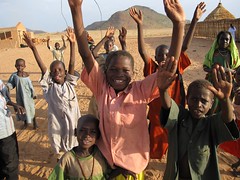
.................................................................................................. i ACT 8 Day 4 "Hello, Mr. Obama" - say the Darfuri children. Malaria - more people suffering from malaria. Is this hope? - Humanity United asked President Obama Uploaded by stopgenocidenow
~~~~~~~~~~~~~~~~~~~~ The Stop Genocide Now iACT 8 team is on the ground now in a Darfuri refugee camp - Camp Djabal These are journal entries from their website
For seven years we have advocated on every level for new policies, new pressure points, for carrots and sticks that may shift or create change on the ground in Darfur. Yet the situation has only gotten worse, not better. As US Special Envoy to Sudan, General J Scott Gration bears the responsibility to personally hold accountable those who are abusing their power in Khartoum and slowly exterminating a valuable culture.
Call General Gration 202-647-4531 and tell him of the conditions in the camps and of the refugees lives. Describe what you have learned through the videos and journals. Make Darfur personal, it is not just a region, it is an entire culture.
To learn more about specific policy asks, please visit the ENOUGH Project.
At about 4:30am, I start to hear the roosters compete for loudest. Then the donkeys follow with their heehawing, along with some confused horses jumping in to the fray. I toss and turn for about an hour, on my foam mattress on the floor, trying to get just a few more minutes of rest before starting another long day. I give up.
The night sky was amazing. The dark dome was completely filled with stars of all colors and brightness, and I had never seen a milkier Milky Way. Although I could really use electricity to work during the night, I was OK with trading those extra hours on our powered-up machines for that view of the vertigo inducing sky.
Today will be another full day at the camp. We have to prep for a live video conference that will happen tomorrow, connecting a Washington, DC VIP event with the camp and our VIP refugee friends, celebrating World Refugee Day. The camp has about 17,000 of these VIPs, so we can only invite a few.
We are also preparing for a marathon of live-streaming on the actual World Refugee Day, June 20th. We will show camp life, walking the camp, as we regularly do for i-ACT, but this time with a camera that is feeding a live stream through the web. You can see this at refugeedaylive.org, with the show starting at 9am EST. You get to walk the camp with us!
On our walk yesterday, I met an older woman named Jimya. She has one sick eye and two sad eyes. She lives alone. When she thinks of home, she sees her field full of trees and vegetables. Everything was destroyed by janjaweed, but she still sees it. She wants to go back, but not now. Peace first, she told me. She was collecting water. Jimya had the two smallest container from all the women at the water station. It’s all she can carry.
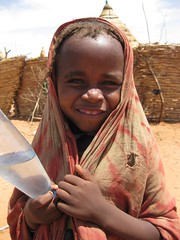
Since arriving in Goz Beida, the last two days have been a blur, more so than the five days of travel to get here. My overwhelming impression is that for a group of people that have been displaced from their homes and forced to live in a refugee camp, the residents of Camp Djabal still have a trust and openness I rarely find. Without fail, every single person smiles back when I acknowledge them. They let me in. I hold a grudge over things and lose trust in humanity for things so small, and here I’m meeting a group that has every reason not to see another human being without thinking there’s a large risk, yet they continue to show love like nothing has happened. I need to learn that trick.
Of course, it’s not a trick. It’s a way of life.
Over the blur of images from the last two days, I have images of endless smiles and the sound of continuing laughter. The kid’s are obsessed with the blonde hair on my arms, and they are constantly running their hands along to make sure it’s real. I had expected, as said in my previous entry, that white people entering the camps with video cameras was a common site, but every time I show anyone their own image on the video, it’s like magic. They are so overjoyed to see their faces, that one might suspect Darfurians are narcissists, but it’s obviously not that. I believe they are just pleased to be acknowledged, even if it’s by an inanimate object like a digital video camera. And of course, I like anyone who thinks I’m funny. They’re either laughing at me or with me, but I don’t care.
One clear preconceive notion that has been wiped immediately away is that this is not a group that needs pity. They are not helpless. Not even close. Neither I, nor those westerners that have walked here before me are any types of saviors to be put on a pedestal. We all merge into the cacophony of support that any human would need being in a refugee camp, but are mostly witnesses to an undeniable force of endurance and adaptability. The 17,000 people in this camp are not waiting around for the western world to save them…there is no moss growing on these rolling stones. They are hard at work, educating themselves, creating homes out of the environment, and keeping the family unit in tact, all while advocating to anyone that will listen that they want one simple thing….to go home. Ian
This environment is unforgiving. I have been in Chad during various seasons, and in June twice. This trip is one of the hottest I have experienced. An almost humid, but also dry heat that you just cannot escape or cool down from. When there is a breeze, you almost always miss it for one reason or another. This is an environment in which only a few cultures can survive sustainably.
My culture would try. But without the vast experience of generations passed down from those who have cultivated from this land, I feel we would not be able to do it.
Women do much of the daily work, and many times most of any type of work in the camps. Today men worked together on two prototype homes that would better protect them from fires that have swept through the closely-knit sectors, destroying many straw tukuls at a time. In my experience here, this image of men working is a rare one. It is usually the women who dig the dirt, add water, mix, and form bricks. Carrying one or two upon their heads, laying the foundation, and solidifying the structure with “poto poto” or clay.
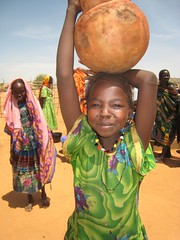
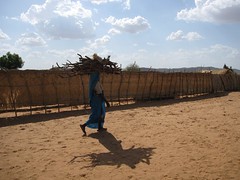
The women and girls are the ones who fetch, and carry on their heads water for the day. Each and every day they do this. Many must leave the camp to collect firewood and we continue to hear stories of the threat of violence against them for doing so. This journey takes anywhere from several hours to the entire day. Some are lucky enough to have donkeys to help carry wood. Several women I have seen this trip carry the wood upon their heads. How many miles did they walk?
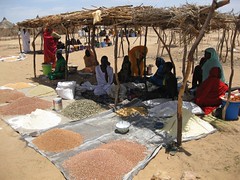
In Darfurian culture, like in most, the women make the meals. We saw vendors at the camp market, many were trading their rations for other things, like meat, dried okra, or sun-dried tomatoes. Items we think of as everyday necessities – vegetables and protein like meat – are a rarity for the average Darfur refugee. They hand grind the sorghum rations with a standing mortal and pestal.
The government of Chad has allowed them a few kilometers to cultivate this season, and many are beginning to plant before the rains come. At least they can do this here, rather than risking their life to return to Darfur for the extra food. The walk to the garden is far and long, but worth the energy.
I am constantly and consistently amazed at the work ethic in this culture. I am not sure I would be able to do all the same things in one day and still smile and exude the beauty of the Darfur people of Djabal. I am not sure very many people would be able to survive in this land. Let alone in a way that is so different from their traditional life.
The strength, the stamina, the courage, the beauty of the Darfur people needs to be preserved and fostered. It must survive.
Our world gets smaller as cultures are lost. Our world must remain big and full, as we all still have so much to learn.
Today, Thursday June 18, 2009, Secretary of State Clinton will be attending a special event for World Refugee Day in Washington D.C. with Angelina Jolie, Anderson Cooper, and the United Nations High Commissioner for Refugees Anontio Guterres. i-ACT will be bringing our friend Rahma from Chad, through video, to meet Secretary of State Clinton. You too can be part of i-ACT by TEXTing Cinton at 90822. Send her this message:
Today you met refugees from Camp Djabal. What are you doing to help them return home to Darfur?
When I was younger, and voicing my concerns about a situation, I would whine, “It’s not fair.” And my mother would simply state the truth, “life is not fair.” My complaints were trivial, but her answer could not have been more true.
All the paths of a refugee camp end up looking the same. Especially in Camp Djabal where high straw fences line the camp and section off compounds. We cannot find Rahma’s house on our own instinct, and we soon give up and ask a group of boys huddled under a tree.
They repeat Rahma’s full name, and begin walking. We follow. Gabriel finds a photo of Rahma on his camera and we are assured we are heading in the right direction. We pass through many alley ways and by tents, and straw tukuls, drying clothes flapping in the wind, and women conversing with one another in the shade.
“Rahma!”
“Gabriel”
“Rahma”
“Khadija”
I embrace him with friendship. Gabriel is smiling. Rahma is smiling. Eric and Ian are smiling. New friends and old reunited! The feeling seems mutual. Rahma talks with us for a moment and asks how are our families and the people in America. His English has approved so much.
Rahma is elated that we are here and we can see it dance in his eyes. But as Gabriel begins to ask about his life and family, sadness creeps in. A mixture of emotions. His eyes look down, and he points to the other side of the camp.
“My mother. She is sick. In the hospital.”
We begin to make our way towards the camp clinic. Rahma’s sister, Hawa, is near the entrance, and grandmother sits bedside. Hawa’s eyes are sad and her gaze serious. Their mother has been here for three days. Her aching body lies very still in bed.
“I am angry today,” Rahma shares with us. He doesn’t know what ails his mother.
We seek a doctor and meet with a very gracious and open man. The exchange is translated from French to Arabic to English. I can see the temperature chart. It was high, then down a bit, peaked, and has been going down, but still not stable. He reads off two types of medicine, one of which is the general antibiotic amoxicillin used for infections. Rahma’s mother’s suffers from a pelvic infection. The other medication is for malaria.
I am angry and very, very sad. Will the medicine work? How can her body, which most likely has a low immune system from dietary options, fight both at one time? I know these doctors, with so many patients and such few resources, are true heroes. But my heart reaches out to Rahma and his family. I wish she were some place else with more medical options.
It will be a short time before they know if the medications are working. If life appears to be coming back, she will go home in three days and continue the medication there. If she simply does not regain strength, then she will be transferred to the hospital in Goz Beida.
After many more hours in the camp and testing live video feed for both tomorrow’s event with Angelina Jolie and Secretary of State Clinton and Saturdays 4 1/2 hour live show, we return to our small compound for an hour to shower before heading to the UNHCR office to work, and sleep as we can. As the others shower, I sit, drink water and begin to cry as I think about Rahma and his mother.
I think of my own mother and the medical care she and I have access to. She is my only mother, and for so long, it was only her and I. I cannot imagine what it would feel like to be Rahma, or his sister, or grandmother. I cannot imagine my mother falling ill with such things that are easily cured and prevented, but could be life threatening here. All I can do is sit in the dark, watch the approaching lightning storm, wait for the rain, and cry.
Life is just not fair.
~~~~~~~~~~~~~~~~~~~~
Sudan Envoy: Darfur experiencing 'remnants of genocide' -- Says aid capacity back near 100%
I don't believe that aid capacity is back near 100%
President Obama's Special Envoy for Sudan Scott Gration, a retired Air Force general who grew up in Africa, today refused to describe the situation in Darfur as ongoing genocide.
"What we see is the remnants of genocide," he said, implying the wartorn region's worst violence is behind it.
"It doesn't appear that it is a coordinated effort that was similar to what we had in 2003 to 2006," Gration of the violence.
His hesitation stems from disagreements within the Obama administration, and pressure from interest groups like the Save Darfur Coalition.
Sources say Gration has reported back from his trip to Darfur earlier this year that the level of violence in Darfur does not currently warrant being called genocide, but officials like UN Ambassador Susan Rice, who served as top Africa official at the State Department during the Rwandan genocide, insist the situation should still be labeled as such.
In fact, just two days ago during a speech in Vienna, Austria Ambassador Rice described the situation in Darfur as "genocide."
At a press conference in Germany on June 5, a day after his major speech to the Muslim world speech, President Obama referenced his comments on Darfur in the speech as "genocide that's taking place."
The Bush administration frequently used genocide to describe the violence in the region after then-Secretary of State Colin Powell branded it as such in 2004.
Gration's approach appears to be more holistic than that of his predecessors, whose attention was mainly on the conflict in Sudan's Darfur region. Instead, Gration says he is working to address all of Sudan's problems, but it appeared his emphasis was on the deteriorating conditions in Southern Sudan, where a tenuous peace deal that ended Sudan's bloody civil war is up for referendum in 19 months.
Gration said violence in the south has seen an "uptick" and is now in fact greater than the violence in Darfur.
Gration said that aid capacity in Darfur is back up near 100% and may soon exceed capacity before 13 aid groups were expelled earlier this year. Sudan has allowed remaining aid groups in Darfur to beef up capacity and has allowed three new groups to come in and pick up the slack.
"We've been able to work with the government of Sudan and NGOs and United Nations to restore humanitarian assistance capacity in Darfur," he said. "We've essentially closed the humanitarian gap that existed in Darfur when the 13 NGOs were expelled."
He said much of the capacity now is emergency work, Gration warned, but he said he hopes soon that will be transferred to sustained aid projects.
--Kirit Radia
~~~~~~~~~~~~~~~~~~~~~~~~~~~
Remarks by Ambassador Susan E. Rice
US Permanent Representative
on the UN Security Council and the Responsibility to Protect
at the International Peace Institute Vienna Seminar, June 15, 2009
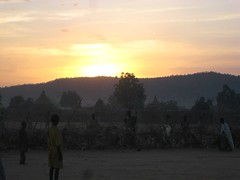
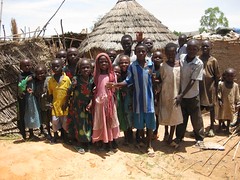
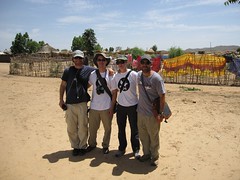
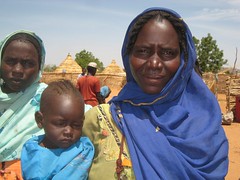
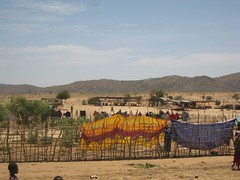
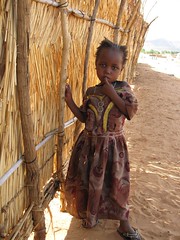
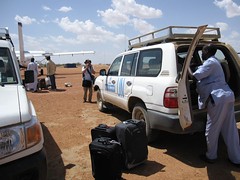
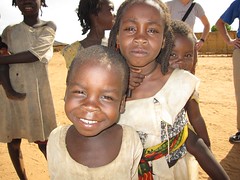
Pictures taken at Darfuri refugee Camp Djabal June 17, 2009
President Obama apparently found it easy to speak articulately about Darfur based on morals before he was President. And now, we see him doing nothing helpful about Darfur.
Maybe, after he turns around the economic crisis. Maybe, after he gets the health care insurance passed. Maybe, after he solves the climate crisis. Maybe, after he closes Guantanamo. Maybe, after Afghanistan, maybe after the Iraq troups come home, maybe after he finds Osama Bin Laden. Maybe, then he'll address the 6 year genocide. Because as it turns out, Darfur is not on his radar screen.
But then, maybe he will not keep his word about Darfur ever.
"The United States has a moral obligation anytime you see humanitarian catastrophes…we have the most stake in creating an order in the world that is stable...in which people have hope and opportunity and when you see a genocide whether it's in Rwanda, or Bosnia or in Darfur - that's a stain on all of us, that's a stain on our souls...I was the first along with Senator Brownback to focus on ratcheting up sanctions and getting an envoy in there who was serious. We worked diligently to get the Darfur Peace and Accountability act passed…I think the level of commitment and the way that I’ve spoken out on this issue indicates not only knowledge, but also passion in bringing an end to this crisis. It’s very encouraging to see activism based not on self-interest, but on moral imperative and it’s especially heartening to see young people engaged in expressing their idealism through this movement …We can't say 'never again' and then allow it to happen again. And as President of the United States I don't intend to abandon people or turn a blind eye to slaughter.” See it here: www.youtube.com/watch?v=QEd583-fA8M November 2007
................................................................ iACT 8 Day 2: Camp Djabal The Stop Genocid Now field team arrives in Camp Djabal for the 4th time. Uploaded by stopgenocidenow
During the Holocaust, there was a couple living in Germay who learned to the truth of what the Nazi regime was doing. For as long as they could, they left flyers in public places telling this truth. They didn’t know if it made a difference, but it was all they felt they could do. They risked their lives to stand up against the Nazis. They were courageous. Their flyers made history because they did reach people. Take a risk, step outside your own comfort zone.
Print 10 of these flyers, cut them in quarters, and leave them in your community. It might be a risk, but it is something we can all do. You never know who will pick one up.
We arrived at camp Djabal at about 2:30pm, which is pretty late to be starting work at a refugee camp. Djabal is a very convenient camp, though, because it is only about a 10 minute drive away from town. The camp looked empty, since people get away from the heat and out of sight during those impossible middle hours of the day. Once we got down from the car at the edge of the camp, children still ventured out to meet us, and pretty soon we had a large crowd of boys and girls ready to be entertained by the weird visitors with all kinds of gadgets.
It’s hard for me to explain the feeling I get at visiting camp Djabal. It feels very familiar, and the friends we’ve made come running to us and give us hugs and smiles and say our names many times in a clear gesture of connection and community. It is my third visit to Djabal. I will be back more times, and we will stay connected, even when not here. Our friends in Djabal know that.
It feels like home, I would say, but it is not really even their home. We are in an interesting position, coming in as i-ACT, an independent group of more or less citizen reporters. We want to help the voice and the face of the refugees get out there. They have a voice. They know what they want to say! Only they feel that nobody has been listening for years.
When we, the i-ACT team, talk about conditions in the camp, it is in no way meant as a negative criticism of people doing the heroic–and I mean this, heroic–work of providing services in these impossible conditions. Are refugees always 100 percent accurate in their sharing of information? No. Nobody is. We do spend extended time with the people in the camps we visit. We do not parachute in and then run out with the stories, developing them later at a safe distance. We are there with them, sitting by their tent, seeing what they talk about, and coming back the next day. We do not get close to walking in their shoes. We try to get close to walking next to them.
It is a complex situation. What we all agree on, I am sure, is that no population deserves to be brutally displaced from their homes, to have family and friends killed, to see sisters and mothers raped, and to have no say in what and where home is.
Besides all the mixed feelings that come with coming in to this complex situation, I feel privileged at being able to act. Our little team, and you probably really have no idea how little we are and what my team mates go through to be a part of it, gets to put a face on the numbers. We need you. We need the people out there that will be open to listening and then will be ready to act. Let’s simplify. It is fellow human beings that are in need.
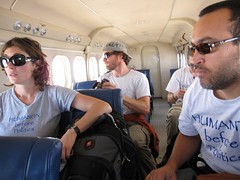
As we fly from Abeche to Goz Beida, I begin to feel at ease; we are on our way and soon will be among old friends. This journey is now familiar.
Out my window in the plane, trees grow near dry tributaries that stretch across the sand like the veins of a drying country. Small circular compounds number that number no more than 15 make up villages sprinkled across the harsh desert, each next to its lifeline, the dry river bed known here as a wadi. Red sand stone and dry green shrubs contrast the neutral sand that covers most the land. As we head South, there is more vegetation and less dry open pits of the Sahara.
Once landed we quickly stop at UNHCR, many of the same faces as only a few months ago greet me with the traditional three kisses to the cheeks. A quick but causal stop with camp police that leaves us free to move back and forth for the week.
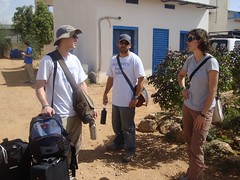
We are pressed for time to test equipment for World Refugee Day so we drive to the outskirts of the camp. Kids surround us quickly and Eric begins set up of the technical equipment. Ian, Carlos and I begin to walk the camp and of course, we are taken in by laughing, name repeating, scurrying bare feet of children and the sounds of a refugee camp.
Grain mill beating in the distance. Laughter and shrieks. “Salaam Malakam.” “Malakam Salaam.” “Humdallah.” “Akram, Akram,” as the kids point to themselves, asking for the next picture to be of them.
Singing draws us towards the teen center. Before I even enter, a familiar face and an outreached hand, Suliemen, our dear teacher friend from New Sudan school. Selma and Zam Zam are in the choir. I give Selma a big hug. I missed her on our last trip because I was sick. Another big hug, I tell her my mother loves and that I promise to find her again. Ali, Zaineb, Amouna, they all begin to gather. And as a family of old friends, we walk back towards the water tower to find Gabriel. We laugh and giggle, speak broken English and hold hands. Amouna teases me as she always has.
Once back home at our Intersos compound, I begin to feel sad. Many of the children we played with today do not know Darfur. They are too young. They only know the life of a refugee in a camp. They have not felt their culture alive in their homeland. They have not danced on their soil, nor been feed from their mother land. Their veins and blood are Sudanese, but much longer in camps like these, their entire traditional world will be like the tributaries spreading from the wadi, dried veins of a country.
* Khartoum forces still attacking Darfur civilians
* UN rights investigator also concerned at killings in south
* Mandate of Sima Samar on line at Human Rights Council
By Stephanie Nebehay
GENEVA, June 16 (Reuters) - The U.N. human rights investigator for Sudan said on Tuesday that Khartoum's forces continue to carry out land and air attacks on civilians in Darfur, and arrest and torture activists and aid workers there.
Sima Samar, U.N. special rapporteur on human rights in the Sudan, also voiced concern at "large scale killings" in the south, where several hundred civilians died in inter-tribal clashes in March and April amid growing violence in the region.
But diplomats said Sudan was trying at the United Nations Human Rights Council this week to win backing from African and Islamic states to block Western attempts to extend her mandate to report on violations in Sudan for a further year.
"I continue to receive reports of arbitrary arrests, detention, as well as allegations of ill-treatment and torture of human rights defenders and humanitarian workers by security forces," the former Afghan deputy prime minister told the 47-member forum.
Her latest report, covering from last August to her visit to Sudan earlier this month, was also issued on Tuesday. "Land and air attacks by government forces on civilians in Darfur took place during the reporting period," it said.
Air attacks in Darfur are banned under U.N. Security Council resolutions and failed ceasefires, but Khartoum has in the past reserved the right to attack the Justice and Equality Movement and other rebels who did not sign a 2006 Darfur peace deal.
The United Nations says six years of conflict have killed up to 300,000 people and uprooted more than 2.7 million in Darfur. Khartoum says 10,000 people have died.
The International Criminal Court has issued an arrest warrant for President Omar Hassan al-Bashir on Darfur war crimes charges.
All sides in Darfur have committed alleged killings, torture, and sexual violence against women and children, Samar said. Three peacekeepers have been killed during the period.
AERIAL BOMBARDMENTS
Fighting in South Darfur in January between the army and rebel forces was marked by "ground offensives and indiscriminate aerial bombardments by government forces in some instances, which failed to distinguish civilian communities, properties and objects from military targets", according to her report.
But Abdel Daiem Zumrawi, under-secretary at Sudan's justice ministry, dismissed her speech and 22-page report, charging that they "failed to give a true picture of human rights in Sudan".
Her mandate, established in 1993, was based on "legacy", and magnified weaknesses rather than progress, he told the council.
Samar's mandate is set to expire when the council's three-week session ends on Thursday.
The European Union is trying to salvage the mandate, one of eight remaining U.N. rights investigators assigned a specific country. In recent years the council has dropped its investigators on the Democratic Republic of Congo, Cuba, Belarus and Liberia.
"They have to acknowledge their problems. The denials of the problem is not going to help," Samar said of Sudan's government.
Asked why her mandate should be retained, she said, "It's a bridge between the international community and that country, first of all. Secondly, I think it is a voice for the voiceless people who are living under difficult circumstances." (Editing by Louise Ireland)
~~~~~~~~~~~~~~~~~~~~~~~~~~~~~~~~~~
Sudan expects removal from US sponsors of terrorism
June 15, 2009 (KHARTOUM) — The Sudanese foreign minister Deng Alor today told the parliament that he expects easing of US economic sanctions and removal from the list of states that sponsor terrorism.
Alor was providing legislators with the state of Sudan’s foreign relations and performance of his ministry.
The top Sudanese diplomat came under fire from the parliament speaker earlier this month for failing to show up for the briefing he made today.
At the time Alor said his appointments prevented him from delivering his remarks back then.
On the relations with Washington the foreign minister said that bilateral dialogue is continuing and will soon lead to steps of normalization including lifting sanctions and delisting from the state sponsors of terrorism.
Alor said that the Netherlands convinced the US that sanctions policy do more harm than good in countries witnessing civil war particularly when the conflict is over resources and wealth.
He also revealed that a number of European countries including Germany and Sweden agreed to partially resume economic development aid to Sudan.
Hungary and Slovakia decided to forgive Sudan’s debt, he added.
The foreign minister hailed the cooperation between Sudan and the African Union (AU) as well as the United Nations (UN) on the deployment of Darfur peacekeepers and humanitarian work.
He also valued the role played by the AU panel headed by former South African president Thabo Mbeki looking into ways to resolve the Darfur crisis while ensuring accountability.
Alor said that efforts by his ministry and support received from Arab, African and Islamic countries against the International Criminal Court (ICC) issued for president Omer Hassan Al-Bashir last March.
He said this resulted in the failure by the ICC prosecutor this month to convince the UN Security Council (UNSC) to take action against Sudan for not cooperating with the court.
~~~~~~~~~~~~~~~~~~~
Are Darfuris sold out in a Deal between NCP and the U.S. Special Envoy?
That is the general feeling among Darfuris in the IDP camps, in the Diaspora, among activists. This is why: 1- Atrocities still going on in Darfur against the people of Darfur, specially the most vulnereable.
a) rape of two women yesterday outside a camp in Zalengie (West Darfur). The women were out to get firewood ( sounds familair?).
b) Pro-GoS death squads continue to carry out assasination operation against Darfuri activists and civil society leaders in Daerfur to suppress any activity calling for the rights of Darfur people. Latest victim was Shoumo Adam, the Activist in Zalengie ( West Darfur) who was assasinated inside his home two days ago. Such activities are on the rise and many Darfuris think that the GoS ( Government of Sudan) is getting no condemnation or rebuke from Washington.
2-The Leaders of the main Movements ( JEM & SLM/Abdulwahid) expressed their dismay that General Scott Geration when met with them in Paris and Chad started to exert pressure on the rebel leaders echoing demands of the Government of Sudan, Arab League, AU.
3- IDP refugees in the Camp and Darfuris in Diaspora are complainig that General Gration invests his time in meetings more with parties who are not Darfuris. Many Darfuris see the Special Envoy on the way to make the same mistake as was made by Robert B. Zoellick ( Abuja peace agreement) by ignoring the input of the people who are the victims of the Genocide in Darfur.
4- It is clear that the GoS is very pleased with General Gration's handling of the humanitarian crisis in Darfur ( which is the making of the GoS in the first place). Please read the issue of June 15 at: While We Wait
5- The media in Khartoum and the net expresses clearly that the GoS has succeeded in diverting the issue of Darfur into bilateral relationship and the common intersts of the two countries on the expence of the Genocide in Darfur.
6- The conference in Washington tobe held these days has failed to outreach to Darfris in Darfur, in the Diaspora. There may be some Darfuris participating in the conference. But many Darfuris don/t consider them to represent the people who are suffering in Darfur.
7- The current handling of the crisis in Darfur by the Administration is a single tracked approach. i.e. focusing in the long term solution while ignoring to address the critical humanitarian and security situation on the ground in Darfur. In few days (June 20th) it will be 5 months ( 150 days) since President Obama took office, and still we hear about this (Sudan Policy Review). As a reminder: The Genocide in Rwanda took only 100 days with a loss of more than 800 thousands lives. No wonder that this policy is celebrated by those who have committed the Genocide in Darfur: The Government of Sudan.
From Mohamed Suleiman, a Darfuri who is still loosing relatives in Darfur (aunts, nephews, nieces and uncles).
This week, we will commemorate World Refugee Day and highlight its theme "Real People, Real Needs". As we turn our attention to the plight of millions of refugees, I urge you to especially think about the 250,000 Darfuris living in over a dozen refugee camps in eastern Chad. Children make up more than 60 percent of the population in the camps and are facing major challenges in securing something every child deserves - an education.
Enough and partner the Darfur Dream Team recently launched the Sister Schools Program, an initiative to link American middle schools, high schools, colleges and universities with schools in Darfuri refugee camps. The program's goals are twofold: first, to improve the education of Darfuri students living in camps, through the construction and rehabilitation of school buildings, teacher training and provision of sports equipment and other school supplies; second, to foster cross-cultural relationships and mutual understanding between American and Darfuri refugee students through letter exchanges and video blogging.
In March, i-ACT, a member of the Darfur Dream Team, visited the Darfuri refugee camps, where they interviewed students and teachers living in challenging conditions. One such student is a 12 year-old boy named Ali. Driven out of his home by militias, Ali and his family packed everything they owned on to the back of one donkey and walked for two weeks until they reached Djabal refugee camp in eastern Chad. Ali, now in the fifth grade, has lived in Djabal camp for the past four years. Displaying unique resilience in the face of extreme conditions, Ali dreams of one day becoming a doctor. However, a shortage of qualified teachers, poorly built school buildings, and lack of supplies makes it difficult for Ali and his peers to realize their dreams.
Here is a video profile of Ali's life in Djabal Camp:
Although the on-going conflict in Darfur prevents Ali and his family from returning home, we can improve the conditions and circumstances they face through the Darfur Dream Team's Sister Schools Program. A simple donation of $82 will provide a Darfuri refugee student with textbooks, school supplies, teacher kits, and sports equipment. I strongly urge you to take immediate action today by visiting our online registry. Additionally, you can have your school or alma mater join the Sister Schools Program at www.darfurdreamteam.org.
What I wrote to President Obama today at the above link:
What is your policy as President on genocide and Darfur?
I am very disappointed that you have taken no leadership regarding Darfur. You promised you would act when you were a candidate.
All of us who have been volunteering our time and work toward ending the active and passive genocide by starvation, dehydration, disease and rape of the Darfuris for five years are very disheartened by President Obama's silence on this issue. And the Darfuris at the refugee Camp Djabal renamed their school for the children the Obama School. They believed a President Obama would act on their behalf in some beneficial ways. They feel let down now.
The iACT Stop Genocide Now team is in a Darfuri refugee camp right now, June 15 - 24, 2009, reporting daily on Youtube and their website. And the teacher at the Obama School at Djabal's refugee camp told them yesterday that maybe President Obama made previous promises about Darfur because "he was candidate". "The United States has a moral obligation anytime you see humanitarian catastrophes…we have the most stake in creating an order in the world that is stable...in which people have hope and opportunity and when you see a genocide whether it's in Rwanda, or Bosnia or in Darfur - that's a stain on all of us, that's a stain on our souls...I was the first along with Senator Brownback to focus on ratcheting up sanctions and getting an envoy in there who was serious. We worked diligently to get the Darfur Peace and Accountability act passed…I think the level of commitment and the way that I’ve spoken out on this issue indicates not only knowledge, but also passion in bringing an end to this crisis. It’s very encouraging to see activism based not on self-interest, but on moral imperative and it’s especially heartening to see young people engaged in expressing their idealism through this movement …We can't say 'never again' and then allow it to happen again. And as President of the United States I don't intend to abandon people or turn a blind eye to slaughter.” http://www.youtube.com/watch?v=QEd583-fA8M November 2007
President Obama apparently found it easy to speak articulately about Darfur based on morals before he was President. And now, we see him doing nothing helpful about Darfur. We are disappointed with Scott Gration, the special envoy to Sudan.
This is a deeply defining issue. "Our lives begin to end the day we become silent about the things that matter." Martin Luther King On World Refugee Day - Saturday June 20, 2009, the iACT Stop Genocide Now team will be live web streaming from Camp Djabal.
Thank you for your attention.
Most sincerely,
Sandra Hammel Genocide Will Stop Only If We Have the Political Will
Where there is a will there is always a way and where there is no will there is no way.
~~~~~~~~~~~~~~~~~~~~~~~~~~~~~~~
You can also write to the President at: The White House 1600 Pennsylvania Avenue NW Washington, DC 20500
President Obama can be called:
202-456-1111 or 1-800-GENOCIDE
The White House comment line is available 9:00 a.m. - 5:00 p.m. weekdays
I just wrote my third letter to the President in the last few weeks. Here it is :
Dear President Obama or whoever reads this,
I am one of Mr. Obama's supporters who went outside my box of comfort and workded door to door, made phone calls and went to New Hampshire the full week prior to Primary Day though I live in Rhode Island. I am so disappointed in Mr. Obama's lack of willingness to stand the line for justice regarding wiretapping and holding GW Bush accountable. Principles are more important than maneuvering through the land mines of politics, Mr. President.
And I am so very disappointed that Scott Gration is over in Sudan shaking hands with the devil. You can't do business with known terrorists and genocidaires. It is not difficult to know the behavioral history of Bashir and his gang of fraidy cats. When he is out of office, those very same people will run like the weak people that they are. I am so very disappointed in our new President. I write about this on my blog http://ilovemylifebrothersandsisters.blogspot.com/2009/04/shame-on-you-president-obama-letting.html and I have made my very first youtube videos speaking to Mr. Obama. http://www.youtube.com/watch?v=denHKveyLc4
And when I have written in the past, here I have always sent a duplicate letter to The White House via USPS. And the one time I got a response it had nothing to say about the issue I raised - Darfur. Obviously, no one really read what I took the time, effort and heart to write about.
Sincerely hoping you'll so do something about the "Stain on our Souls" - as you put it when talking about the responsibility to act regarding Darfur. http://www.youtube.com/watch?v=QEd583-fA8M Read Matthew 25. I think it is fitting and appropriate.
Thank you, if anyone actually read this.
Sandra Hammel
We're not well until we're all well. Mary Sanger
NOT ON OUR WATCH, MR. OBAMA
~~~~~~~~~~~~~~~~~
Write to President Obama http://www.whitehouse.gov/contact/ You can also write to the President at: The White House 1600 Pennsylvania Avenue NW Washington, DC 20500 President Obama can be called:
202-456-1111 or 1-800-GENOCIDE The White House comment line is available 9:00 a.m. - 5:00 p.m. weekdays ~~~~~~~~~~~~~~~~~~~~~~~~~~~~~~~ Find USA elected politicians contact information at this link: www.usa.gov/Contact/Elected.shtml ~~~~~~~~~~~~~~~~~~~~~~~~~~~~~~~
Shame on President Obama. If you have read my posts over the last couple of years, you know I worked to get Barack Obama into the Presidency office. But he is not upholding justice in two regards. One is his Attorney General and the principles of justice and the U.S. Constitution. Principles are more important than maneuvering through the land mines of politics, Mr. President. ..................................................................
And the other is on Darfur. He is having his Sudan Special Envoy, Scott Gration shaking hands with the devil. Advocate campaigns for Darfur
Special note: I haven't fallen off the earth. Just overwhelmed with learning how to do videos. This one below took me all night long last night. I have to get some sleep. I know those of you who count on me for Rafa Nadal have been wondering. He had an off game in Miami and unfortunately had to move on. What a disappointment that the final was so poorly covered by CBS here in the USA. Not an interview after with Andy Murray who won and not one second of talk after the final even though the commentators said they were coming back to talk. But they didn't. Not one second of the trophy ceremony. But a whole different story last night about the college basketball final. And it wasn't even a good game. I am very busy now getting organized for my Darfur event for April 18, 2009. I have no one to help me. And the entire day was spent trying to talk to several computer tech people into the idea that they should help me when they said they couldn't or better yet wouldn't. Apple care had me do something and it disabled both my computers from the internet and from my wireless printer. So no catching up from the sleep I lost last night as I had planned and in the end with a little important help from Jay - about my 5th or 6th Apple Care person on the phone today - I managed to do it basically by the seat of my pants. Everything seems to be working again. So. Long story to say that I can't be around the internet too much at all.
I am two days behind posting with the Djabal Darfuri refugee camp pictures and posts. But you can get the information by clicking the Stop Genocide Now's iACT buttons either in my heading or sidebar for the next several weeks as I will leave the buttons up.
I am presently struggling with the ATP TV website for live streaming for the tennis matches. They say I haven't renewed and I did try to. Hopefully will get it sorted out before Monte Carlo.
Need some sleep. At least I'm not in a refugee camp sleeping on the ground.
Hang it there, everyone.
Forgive any mistakes in this post - I can't proofread and check all the links. Gotta - you know eat and sleep. 'night.
This is my third video... ..................................................................
.................................................................. President Obama's Promise to Darfuris Needs Action Now If you click the video a couple of times and go over to Youtube you can see it in a big screen or even bigger screen by enlarging it over there. Uploaded by ilovemylifesblog
This is the text I posted at Youtube:
THE DOVE Words by Ewan McColl Music Traditional
The dove she is a pretty bird, she sings as she flies, She brings us glad tidings and tells us no lies.
Come all you young fellows, take warning by me, Dont go for a soldier, dont join no army. For the dove it will leave you, the raven will come, And death will come marching to the beat of a drum.
Come all you pretty fair maids, come walk in the sun, And dont let your young man ever carry a gun, For the gun it will scare her and shell fly away, And then theyll be weeping by night and by day.
She drinks the spring waters to make her voice clear When her nest she is building and the summer is near. The dove she is a pretty bird, she sings as she flies, She brings us glad tidings and tells us no lies.
~~~~~~~~~~~~~~~~~~~~~~~~~~~~~~~~~~~~~ About the video: The drawings are by Darfuri children - all during the genocide.
The photos are of camp Djabal just over the border from Sudan in Chad. Most photos were taken between March 23 and April 1, 2009 from www.stopgenocidenow.org
Stop Genocide Now team Gabriel Stauring Katie-Jay Scott Yuen-Lin Tan ~~~~~~~~~~~~~~~~~~~~~~~~~~~~~~~~~~~~~ Use Your Voice to Save Darfur RI Director Sandra Hammel QUIET RIOT FOR DARFUR
SIGN UP for QUIET RIOT FOR DARFUR - APRIL 18, 2009 2:00 p.m. at www.savedarfur.org
Press Release
Event for Rhode Island, Eastern Connecticut and Southeastern Massachusetts DARFUR - Six Years of Genocide And STILL Going On All are welcome to attend - The event is free
Saturday, April 18, 2009 2:00 p.m. 3:30 p.m.
Newport Beach, Memorial Boulevard Newport, Rhode Island, 02840
Genocide prevention now has a month and its April. Six genocides started in the month of April. Grassroots events in cities across the United States of America are being held in the month of April - honoring the past and calling for action now for the people of Darfur. President Obama will have been in office for nearly 100 days. Citizens are urging the President to ensure peace for Sudan, protection for its people and accountability for the architects of genocide.
QUIET RIOT FOR DARFUR We will be honoring the Darfuri dead, the wounded and the surviving Darfuri people who live as campers all the days of their lives. We will hear the current story of one Darfuri family - what its like for them in the refugee camp over the border in Chad. This one family will symbolize all of the victims of the inhumanity happening right now. Real people living in survivor mode. Not a TV show.
Since Sudanese President Bashir learned of his arrest warrant by the International Criminal Court March 4, 2009, he immediately expelled 16 humanitarian aid men and women who had been keeping the Darfuri people alive in refugee the camps. With no water, no food - diseases have since been spreading in these camps. An emergency is present. Truly the resolve of life and death hinges on these agencies being allowed back into Sudan to try to save lives.
Bring to QUIET RIOT FOR DARFUR 1) Dear President Obama signed hand written or typed letters ready to be sent in solidarity to our President. The Purpose of the Letter: Tell in your own words why it is important to you that he act in the best interest of the Darfuri families. Letters will be collected and sent to President Obama. 2) Handful of flower petals to honor the dead. 3) A candle to light to symbolize each persons concern for those in need.
~~~~~~~~~~~~~~~~~~~~~~~~~~~~~~~~~~~~~ Find and event ACT NOW FOR DARFUR in your area.
Go to their website for great pictures and stories of their trip to Djabal - a Darfuri refugee camp just over the Sudanese border in Chad where Gabriel Stauring, Katie-Jay Scott and Yuen-Lin Tan were sending back videos from March 23, - April 1, 2009.
It has been more than a year since I met Adef and his beautiful family, but he received me at his home with such joy and recognition that it felt as if we were best friends, reuniting after a short time apart. The smile on my face lasted a few minutes, until he told us that their baby, Marymouda, had past away not too long ago. It is Adef and his wife Achta’s second loss, since leaving Darfur.
This trip was filled with such moments—joy followed immediately by sadness, many times both flowing together through the same time and space.
We are now safe and on our way home. I can’t wait to see my children, hug them and kiss them. Adef’s daughter, Guisma, let me carry her, and she smiled—now and then. On our previous trip, Guisma did not stop laughing, and it was all-out, contagious laughing! This time she looked thinner, and there was sadness behind her beautiful dark eyes.
If you are one of the few people that read these e-mails of ours, you are already committed to helping Guisma and the millions of Darfuris that live away from their destroyed homes. For a change, on this e-mail I will not ask you for anything. Instead, I want to share the gratitude that every single refugee expressed and asked us to pass on to you. They thank you for doing what you can to bring peace, protection, and justice to Darfur. They thank you, from deep in their hearts, for listening to their stories.
I love my life. I love where I live. And I am passionate about my passions. I love to dance. Necessary to live: music, piano, singing, writing, acting, painting.
I have been fighting for and supporting the arts all my adult life. Since 2004, I have been working with other activists to end the Darfur genocide.
I have traveled to Europe many times since my early twenties. Places I have been: many USA states including Hawaii, Montreal, Canada, Barbados, France, Spain, Luxembourg, England, Austria, Switzerland, Italy, Greece and Germany - and have wonderful memories.
My last trip was in May - June 2013 to Spain.
I would like to travel to Europe and Kyoto, Japan.
I love the southwest where I have visited Hopi, Navajo, Zia and San Idlefonso potters.
Life is exciting and I intend to live it full-out to the end.
B.S. and M.M., both in music
................................................
Khartoum, Sudan Stop Genocide Time
................................................
Spain Time
................................................
Melbourne Time
................................................
Hawaii Time
...............................................
...............................................
RAFA NADAL -BRING BACK LONG PANTS - SLEEVELESS TOPS
Double Click on Videos to Enlarge
Darfur - The Abandoned Genocide - a video by Sandra Hammel
Want to help? Call 1~800~GENOCIDE
"May I Suggest" by Susan Werner
Satchita - Playing for Change
Stand By Me ~ Playing for Change
~~~~~~~~~~~~~~~~~~~~~~~~~~~~~~~~
Genocide is not only a word,
it is crying of the whole human race.
There is nothing redeeming about being silent
when speaking up is the humane thing to do.
The honor and integrity of the human race is at stake.








 Enough and partner the Darfur Dream Team recently